'The issue of the larger homeland of Nagalim, the dream of the Nagas to hold sway over swathes of Manipur, Assam and Arunachal Pradesh, is just that, a dream.' 'The NSCN has been told categorically that the government is not going to concede on this issue.'

The government has displayed a tin ear in its responses to the JNU protests by using the sedition law -- and by encouraging lawyers who wear their political affiliations on their sleeves to display utter contempt for the Constitution. The Modi Sarkar has over three years of its term to run. But it may well have already sown the seeds of defeat,' says Devangshu Datta.

'This is basically aimed at vilifying Nehruvian ideals.' 'Why?' 'Because, Nehruvian leadership is seen by Hindutva forces as the one which did not let them have their Hindu Raj.' 'The Hindutva proponents have always assumed that had Sardar become the first prime minister, India could never have become a secular State,' says Mohammad Sajjad.

Discussions to evolve a consensus on separate Telangana state is on and the Congress high command will take a final decision on it but it will take time, Home Minister Sushilkumar Shinde said on Tuesday.

Aseem Chhabra looks at the year's best Non-Hindi Indian movies.

'So far the youth were Modi's strength.' 'It now seems under pressure, and for good reason: Crisis in education, jobs, slowdown in manufacturing, and thereby trading,' points out Shekhar Gupta.

Irom Sharmila's decision to end her 16-year-old fast against the AFSPA continues to be hotly debated and contested in Imphal.

Lok Sabha Speaker Sumitra Mahajan came down heavily on Congress leaders for "persistently and willfully obstructing the House" and suspended them for 5 days. The members who have been punished include a president's son, ex-chief ministers' sons and an ex-CM's grandson. Rediff.com brings you the complete list.

'Goa is about community living, but blending in takes time.'

Taki in West Bengal's North 24 Parganas district is the last Indian outpost on the border with Bangladesh. It is one of hotspots for Bangladeshi infiltration into India. While most poor Bangladeshis cross over to look for work, terror groups take advantage to ferry their men and material into India. Indrani Roy/Rediff.com reports.
The question is no longer whether he will win 2019; it's what he will do with the new status, says Shekhar Gupta.

The RSS realises that with a majority BJP government at the Centre and in several states, now was the best time to undermine and perhaps outdo the Congress-Left 'stranglehold' over campuses and young minds.
'Sridevi was a responsible mother.' 'I have heard her talking about her daughters.' 'Once in a while, they came on set. She would make sure she had time for them.' 'That's why she could play a mother so wonderfully in English Vinglish.'

Two young designers from Meghalaya are making a positive impact with their skills.
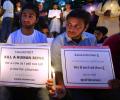
'Most Hindus believe in living in peace with their Muslim neighbours and vice versa.' 'It is this India we have to preserve.'

Rediff.com's Indrani Dey digs up chilling details of the ongoing investigation in the Bardhaman blast case, which exposed the a militant network that had been operating in West Bengal since many years.
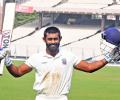
A round-up of Ranji Trophy matches played across India on Monday

'We look and say their life is so tragic.' 'But there are hundreds of millions of people in these circumstances and what can they do but to carry on.'
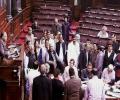
The issue was raised in both Houses of Parliament with main opposition Congress too seeking clarification.

The issue at the core of it is the perceived fear among the locals of getting outnumbered and uprooted by 'others' and eventually losing their identity

'In the first meeting of this new year, we took a joint new year resolution that we will complete it this year. At the time things were not very clear, but the mood was clear that yes, we must resolve it.' 'Yes, details have to come out, but there are some sensitivities, there are some stake-holders not yet on board, especially other Naga undergrounds etc, we would like them to come on board... So at a proper time it has to be revealed to the country, and to the legislature. Perhaps, we may have to wait for some more time.' 'With better understanding of the Indian system, many of them have learnt, realised, appreciated that Naga nationalist aspirations can be accommodated in the Indian system. The Indian system is pretty comprehensive and flexible.' 'A Naga has as much stake, claim over India as any other Indian. There is no distinction. This, Nagas have realised, that yes, Naga nationalist aspirations and Indian nationalism are not mutually exclusive.' Ravindra Narayan Ravi, the Government of India's Special Interlocutor for the Naga talks, explains how the Naga Peace Accord was reached in an exclusive interview to Saisuresh Sivaswamy/Rediff.com

'The Opposition has no option but to make it an 'All versus One' fight to even think about winning.'

She indicated that she was not looking for any financial package but the confidence building measures sought by her should focus on political aspect of the problem.

State after state has imposed an alcohol ban, and has had to retreat, unable to address the financial and administrative fallout. Are we set for more of this cycle, asks Aditi Phadnis.

Yale University has issued a statement saying that Human Resource Development Minister Smriti Irani attended a weeklong programme and received a certificate from the university last year, along with several other lawmakers from India. George Joseph/Rediff.com reports from New York

Economic reforms seem to be on a slow train, while good old fiscal populism is alive and flourishing.

'I am quite optimistic that sooner or later, my wishful thinking would turn into a reality.' The only hitch is that the INC president's own career ambitions may be hurt if the Congress merges with the BJP,' says Sudhir Bisht.

How can 'first food' meet the challenge posed by factory-made 'fast foods' which are backed by marketing money and often come with 'traditional taste' tags attached to them? The first step would be to preserve knowledge about first foods, says Dinesh C Sharma.

Though the list of superstitious beliefs is long, often dissolving distinctions of class, caste, religion and education, Karnataka's anti-superstition bill is seen as a big step ahead.
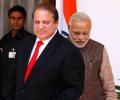
The government has returned to talks with Pakistan, but can it withstand pressure from a jingoistic press and a rabidly nationalistic social media.
.jpg)
Both India and China have demonstrated levels of maturity in diffusing tensions and ensuring that the border remains by and large incident free, says Seema Mustafa
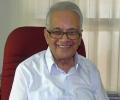
'If you are a professional journalist, don't ever think that your work is going to bring in revolution or that you are going to change the world. That job is best left to the revolutionaries,' M V Kamath, the legendary journalist who passed away on October 9, told Nitin Gokhale.

Like the Hindi film industry, where formulas for hit films are done to death, the political fraternity in India is making an all out effort to 're-brand' itself to follow the hit script of the AAP, says Upasna Pandey

West Bengal was the second-most industrialised state in terms of value added and first in terms of number of factories and employment even in the mid-1960s. With a severe and long process of deindustrialisation, it lost its primacy.

'The blood that runs in the veins of our family can never be anti-national.' 'They called Kanhaiya a traitor for questioning the Indian Army. Do they know that our cousin was killed by militants in Manipur while serving with the CRPF?' Archana Masih/Rediff.com travelled to the land of Lal Salam, Lal Sitara and comrades to find out what moulded India's most talked about student leader, Kanhaiya Kunar.
For India's upstream sector that has seen no new discovery coming into production.

'We have about Rs 4 lakh crore debt on a state budget of about Rs 1.5 lakh crore.' 'We are in a debt two-and-a-half times our annual budget,' says the banker who would have been Tamil Nadu's finance minister had the DMK won.
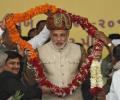
The BJP's prime ministerial candidate Narendra Modi will need to break several records to emerge victorious in the next Lok Sabha elections. Mayank Mishra reports.

Iconic rights activist Irom Sharmila on the highs and lows of her long fast, why she gave it up and her plans.
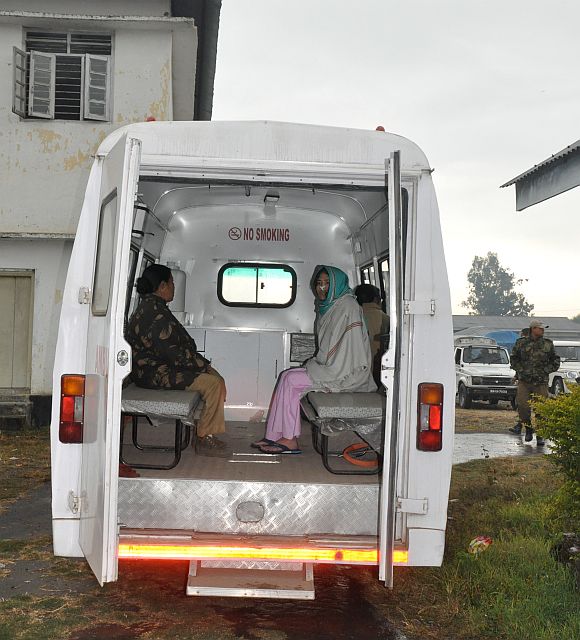
On the occasion of her breaking the world's longest hunger strike, Rediff.com reproduces this 2011 feature on the activist and her life.
